I was just thinking that perhaps I should provide some background on the move. What is happening is that I've decided to transfer from my design program at Pratt to one at California College of the Arts. There are a number of reasons for this decision, some of which concern a practical desire to broaden the kind of design education I'm getting (and frankly, dissatisfaction with Pratt), and some of which concern a personal desire to go back to California, my home state. For an entire year, I've been weighing these two impulses, and even now, after I've made the decision, I'm seesawing wildly between cautious excitement and complete panic.
At the moment, the panic is winning out, unfortunately. I feel a pit in my stomach as the reality of moving day gets closer and closer. Not only am I full of angst about leaving New York, a city I love yet somehow felt was the right time to leave, but I am worried about Chef K, who is supposed to follow me once he gets a job in SF but hasn't found anything yet. And I am worried about leaving my friends at Pratt, an unbelievably special group of people that I was blessed to meet, and honestly feel like I'm tempting fate now to leave. On top of it all, I'm worried that I'm deep-sixing my career, going to some college everyone gets confused with CalArts, or Academy of the Arts, or Art Institute, and going for a second bachelor's to boot. What am I doing?? Am I crazy?
At the bottom of it, I guess that I never wanted to wonder "what if," that I believe there is a bigger world out there in design than what I've experienced so far. Hopefully, if I always hang on to what's in my heart and always ask if I'm staying true to myself, things will turn out OK. I've always told other people that -- and now I need to tell myself. The truth is, though, that I'm terrified.
Showing posts with label design. Show all posts
Showing posts with label design. Show all posts
Friday, August 13, 2010


Saturday, July 24, 2010
On Eating Utensils / Form & Function
A while ago, Chef K brought home a little present for me -- a specially designed espresso spoon by coffee company Illy that he'd gotten from work. As you can see from this picture, it's completely flat, supposedly all the better to stir with.

I couldn't help but think this little bit of innovation was completely unnecessary. Chef K protested, "But you don't need the spoon part!" Yeah, but... what if you want to taste what you just stirred? And if it's just a stirrer, why is the end shaped like a regular spoon?
This in turn got me thinking about utensil design more broadly, and how its evolution has been shaped by not only what we eat but the very culture of how we eat -- how we sit at a table (or don't) and consume food, who we do it with and what we like to do while we're eating.
Roland Barthes famously proposes, in Mythologies, that utensils developed in a necessary and inevitable way from the specific foods eaten by specific cultures, and that such innovations are characteristic of those cultures. Thus, "aggressive" cultures in the West "naturally" created sharp implements -- forks and knives -- to spear and cut their food, while in contrast, the "delicate" cultures of the East developed chopsticks to gently separate and caress theirs. It's a poetic theory, but suspect not only because it essentializes foreign cultures but because it takes without questioning the age-old idea that form follows function.


Henry Petroski, on the other hand, argues in The Evolution of Useful Things that form does not follow function in any straightforward way, that necessity is almost never the mother of invention. Rather, desire, whimsy and, importantly, failure, more regularly dictate the twists and turns of design evolution. This would certainly seem the case when we look at the Illy spoon/stirrer.
The basic forms of the knife, fork and spoon have remained relatively unchanged for the last two centuries, even as the implements with which we cook have multiplied exponentially and grown ever more microscopic in function -- these three items (varying sometimes only by size) have continued to be our sole dining companions, while in the kitchen, we now work with not only ladles and tongs but spaghetti spoons, apple corers, avocado slicers and melon scoops.
As new culinary fashions arise -- molecular gastronomy, for example -- how will these basic eating utensils change? Are fork and spoon adequate to taste... foam? What are the best utensils to sample tiny, pulverized pieces of food, or will new ones need to be created? What will they look like -- and will they stay long in our tableware lexicon?


I couldn't help but think this little bit of innovation was completely unnecessary. Chef K protested, "But you don't need the spoon part!" Yeah, but... what if you want to taste what you just stirred? And if it's just a stirrer, why is the end shaped like a regular spoon?
This in turn got me thinking about utensil design more broadly, and how its evolution has been shaped by not only what we eat but the very culture of how we eat -- how we sit at a table (or don't) and consume food, who we do it with and what we like to do while we're eating.
Roland Barthes famously proposes, in Mythologies, that utensils developed in a necessary and inevitable way from the specific foods eaten by specific cultures, and that such innovations are characteristic of those cultures. Thus, "aggressive" cultures in the West "naturally" created sharp implements -- forks and knives -- to spear and cut their food, while in contrast, the "delicate" cultures of the East developed chopsticks to gently separate and caress theirs. It's a poetic theory, but suspect not only because it essentializes foreign cultures but because it takes without questioning the age-old idea that form follows function.


Henry Petroski, on the other hand, argues in The Evolution of Useful Things that form does not follow function in any straightforward way, that necessity is almost never the mother of invention. Rather, desire, whimsy and, importantly, failure, more regularly dictate the twists and turns of design evolution. This would certainly seem the case when we look at the Illy spoon/stirrer.
The basic forms of the knife, fork and spoon have remained relatively unchanged for the last two centuries, even as the implements with which we cook have multiplied exponentially and grown ever more microscopic in function -- these three items (varying sometimes only by size) have continued to be our sole dining companions, while in the kitchen, we now work with not only ladles and tongs but spaghetti spoons, apple corers, avocado slicers and melon scoops.
As new culinary fashions arise -- molecular gastronomy, for example -- how will these basic eating utensils change? Are fork and spoon adequate to taste... foam? What are the best utensils to sample tiny, pulverized pieces of food, or will new ones need to be created? What will they look like -- and will they stay long in our tableware lexicon?

Saturday, July 17, 2010
Seattle, Part 3: Staying at the Hyatt Olive 8... aka a Meditation on Modern Luxury
I headed home after my afternoon walk to prep for the rehearsal dinner. Chef K was running errands for the groom, so I had some time by myself in our hotel room at the Hyatt Olive 8 to relax and, like a real design geek, check out the decor. The hotel itself is brand-new so the furnishings were impeccably clean and in tip-top shape, the design sleek and modern. Everything, really, was quite "nice" -- but it really got me thinking about "trendy" vs. "true luxury" in contemporary interior design, especially with regard to hotel, restaurant and bar interiors.


So why don't all these elements add up to true sophistication? What makes an interior truly sophisticated? I think it comes down to the details, to high-quality materials, a classic, not up-to-the-minute, sensibility and almost always a sense of personality, a thoughtful eclecticism. Not the kind of impersonal design-by-numbers too often seen in all those bars and hotel lobbies with black-painted wood, blue uplighting, geometric-patterned wallpaper (or damask -- ugh, so 2005), that kind of thing.
I don't really mean to be picking on Olive 8 in particular. In fact, all of the above being said, I would definitely recommend the Olive 8 to anyone traveling to Seattle -- it was a very comfortable stay and great value!!
Take the Olive 8 -- it had all the hallmarks of "trendy." Black-painted wood (OK, plywood): check. Geometric patterned bedding in a cool (as opposed to warm) color palette: check. Copious frosted glass: check. If our room had had those squiggly pieces of "driftwood" (painted black, of course) sold at places like West Elm, I wouldn't have been surprised. And the sliding door to the bathroom -- so "cool," yet so inconvenient.


So why don't all these elements add up to true sophistication? What makes an interior truly sophisticated? I think it comes down to the details, to high-quality materials, a classic, not up-to-the-minute, sensibility and almost always a sense of personality, a thoughtful eclecticism. Not the kind of impersonal design-by-numbers too often seen in all those bars and hotel lobbies with black-painted wood, blue uplighting, geometric-patterned wallpaper (or damask -- ugh, so 2005), that kind of thing.
I don't really mean to be picking on Olive 8 in particular. In fact, all of the above being said, I would definitely recommend the Olive 8 to anyone traveling to Seattle -- it was a very comfortable stay and great value!!
Seattle, Part 2: Shopping the SAM Gift Shop
After saying goodbye to Angelica (she had to go back to work at some point), I spent a super relaxing afternoon walking down First Ave, popping into interesting boutiques here and there. As I got closer to Pike Place Market, I passed the Seattle Art Museum, where the big show seemed to be "Kurt." It took me a minute to realize it was a show about art inspired by famous Seattle native son Kurt Kobain -- which was kind of interesting, but not really interesting enough to justify an expensive ticket (even with student discount) and the attention span required to read wall text.
So I went to the gift shop instead, which honestly is -- I say with no shame! -- sometimes my favorite part of the whole museum-going experience. (What did you expect from a blog called Materialista?) I was especially looking forward to seeing SAM's because I wasn't able to stop by last time due to time constraints (and Chef K's waning patience).
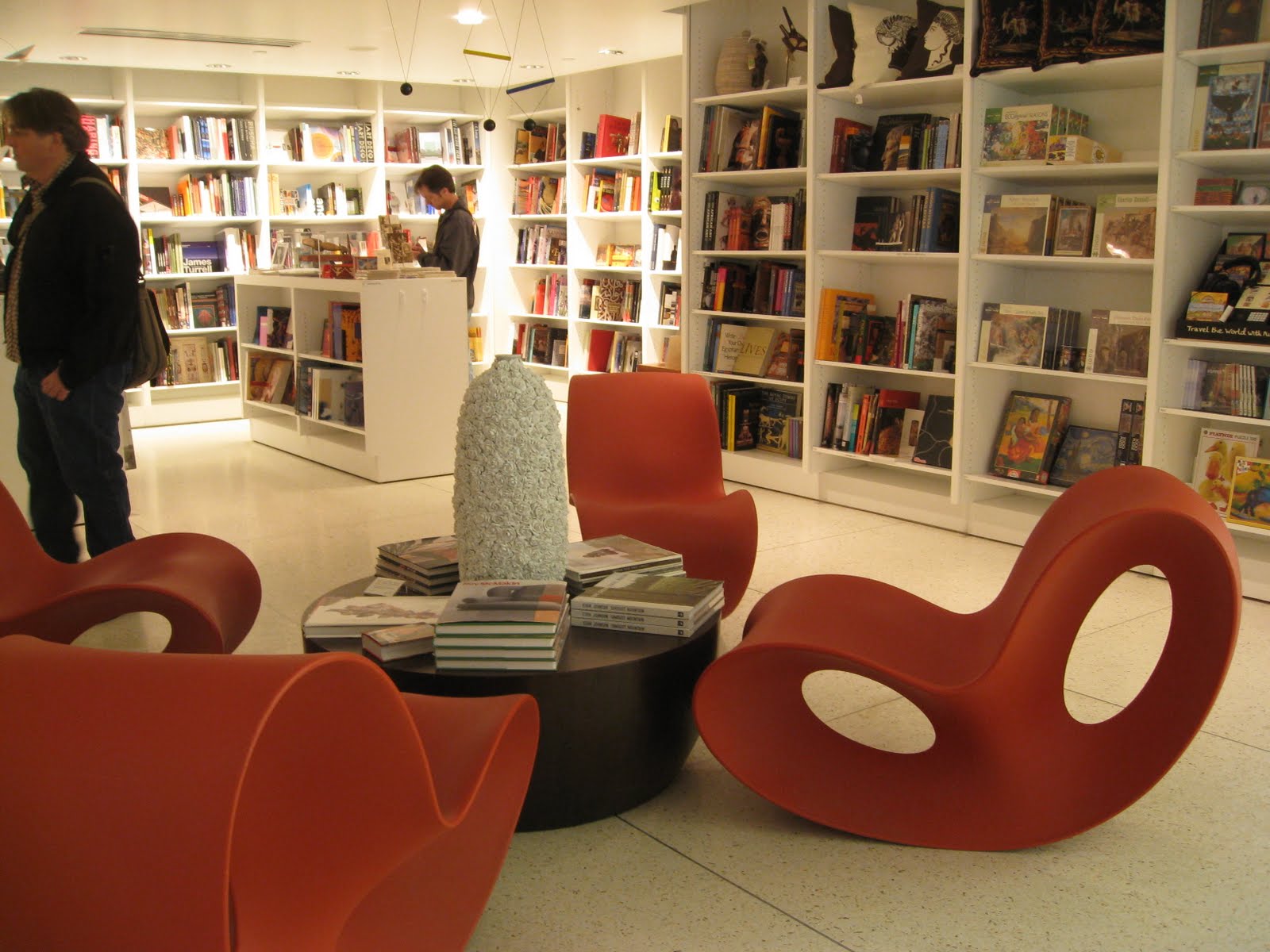
Fun little place! I tried on a necklace made up entirely of red felt loops (very cute and something I could totally make myself) and also admired the red plastic Ron Arad chairs -- you can never sit in the metal ones because they are up on some museum pedestal (literally and figuratively), so it was cool to experience their mechanics in person.


I also liked these woven paper lamps made by a contemporary Japanese designer -- a nice update to Noguchi's iconic Akari lamps.

So I went to the gift shop instead, which honestly is -- I say with no shame! -- sometimes my favorite part of the whole museum-going experience. (What did you expect from a blog called Materialista?) I was especially looking forward to seeing SAM's because I wasn't able to stop by last time due to time constraints (and Chef K's waning patience).
Fun little place! I tried on a necklace made up entirely of red felt loops (very cute and something I could totally make myself) and also admired the red plastic Ron Arad chairs -- you can never sit in the metal ones because they are up on some museum pedestal (literally and figuratively), so it was cool to experience their mechanics in person.

I also liked these woven paper lamps made by a contemporary Japanese designer -- a nice update to Noguchi's iconic Akari lamps.

Monday, July 12, 2010
The 2010 Gowanus Studio Space Jell-O Mold Competition
The GSS Jell-O Mold Competition is, it's probably safe the say, the only event of its kind. For a few years now, local art/design types have gathered annually in this studio space in the industrial no-man's-land between Carroll Gardens and Park Slope to pit their molded jello creations against each others'.
Historically many Pratt peeps attend and/or participate, and this year was no exception, so me and a few other folks moseyed down to show our support. Although I didn't agree with some of the winners ("Ascension Aspic" aka Bloody Mary jello in the form of the Virgin Mary -- EWW!) and some of my friends got robbed (like my fellow Umbra winner Michael Liu, who made fantastic and tremendously tasty "Bouncy Ball" jello balls, complete with a vending machine found off Craigslist), much fun was had all around.
Jello shots for sale:

Adorable Alexis with her dual-flavored jello pills (still can't believe they gave runner-up to the guy who had the exact same concept!):

Michael's bouncy balls:

Of the winners, I thought this one was probably the coolest: stiff agar cups with the appearance of cut glass, filled with different types of homemade herbal lemonade:

Historically many Pratt peeps attend and/or participate, and this year was no exception, so me and a few other folks moseyed down to show our support. Although I didn't agree with some of the winners ("Ascension Aspic" aka Bloody Mary jello in the form of the Virgin Mary -- EWW!) and some of my friends got robbed (like my fellow Umbra winner Michael Liu, who made fantastic and tremendously tasty "Bouncy Ball" jello balls, complete with a vending machine found off Craigslist), much fun was had all around.
Jello shots for sale:

Adorable Alexis with her dual-flavored jello pills (still can't believe they gave runner-up to the guy who had the exact same concept!):

Michael's bouncy balls:

Of the winners, I thought this one was probably the coolest: stiff agar cups with the appearance of cut glass, filled with different types of homemade herbal lemonade:

Salt & Pepper Shakers
Earlier this summer, I designed a set of salt and pepper shakers, which got me thinking about my favorite designs over the years. It's true these little objects are a special obsession of mine; to me, they epitomize a designer's work, and you can judge any tabletop designer's worth by looking at his or her salt and pepper shakers, in the same way that you can judge a furniture designer's worth by looking at his or her chair. They are, to me, the ur-object in tableware design.
So what makes a great s & p set? Basically, there are only two qualities:
1. Simplicity.
2. The perfection of the complementary relationship between the salt and the pepper -- whether on a formal or conceptual level, or both.
By these parameters (seemingly so basic, but in execution rather difficult), some of my favorite examples include:
Scott Henderson's famous "Hug" s & p shakers:

Lola Goldstein's happy/sad creatures (previously sold in a limited edition at the MoMA store -- can't believe I hesitated):


So what makes a great s & p set? Basically, there are only two qualities:
1. Simplicity.
2. The perfection of the complementary relationship between the salt and the pepper -- whether on a formal or conceptual level, or both.
By these parameters (seemingly so basic, but in execution rather difficult), some of my favorite examples include:
Scott Henderson's famous "Hug" s & p shakers:

Lola Goldstein's happy/sad creatures (previously sold in a limited edition at the MoMA store -- can't believe I hesitated):

For sheer fun factor, naughty Scottish artist David Shrigley's set:

And for pure formal beauty, I am a fan of these designs from Muji (complete with matching porcelain tray and miniature soy sauce pot) and Calvin Klein (two incredibly pure brushed stainless steel columns). I own both. :)


What are your faves?
Wednesday, February 25, 2009
Day 21: Taliesen West
The centerpiece of our very last day was a tour of Taliesen West, Frank Lloyd Wright's experimental home-slash-workshop-slash-work in progress in the middle of the Arizona desert. I'm not really a huge Wright fan, but it was fun to see -- and also to learn what a gigantic a**hole he was. (Astounding how the architect stereotype pulls through so many times! Ha ha, apologies to any architect friends reading this... but you know what I mean.)

I was actually more interested in Wright's furniture designs (big surprise there -- check out my post on Donald Judd's furniture). You can see the Asian influence in these "Origami" chairs and table sets:

His doors are also fascinating -- apparently he built them especially low so that you are forced to acknowledge your transition into another space...HIS space.


I was actually more interested in Wright's furniture designs (big surprise there -- check out my post on Donald Judd's furniture). You can see the Asian influence in these "Origami" chairs and table sets:

His doors are also fascinating -- apparently he built them especially low so that you are forced to acknowledge your transition into another space...HIS space.


Friday, February 20, 2009
Nostalgic Signage in Holbrook, AZ
The whole town of Holbrook, AZ, where the Wigwam Motel is located, seems frozen in time -- in a good way! Check out this awesome signage:


Sunday, February 15, 2009
Judd's Interior & Furniture Design
I think it's pretty interesting that Judd made quite a few furniture pieces in his time, and was as rigorous in designing them as he was in making his art.
Nevertheless, he considered design an entirely separate thing from art. Someone once suggested that one of his steel boxes would make a great coffee table; he considered it and then decided it would be blasphemous to make a work of art serve a practical purpose. Design, on the other hand, was purely practical for him.
These days, in our age of "design as art," his furniture sure looks as beautiful and "artful" as his art.

Here is a peek inside a window at some of his chairs. Very boxy, just like his, er, boxes, no?

More chairs... I like how when all of them are pushed in, they look like the legs of the table.

These are what are known as "Judd doors." They hinge from the middle and can only be opened to a 45-degree angle, per his meticulous specifications. At least that's the story the Chinati has. When we went on a tour of Judd's old house in the neighborhood later on in the afternoon, the Judd Foundation pooh-poohed that and said there was no need to be so strict: "Oh, we're not going to yell at you if it's not at that exact angle." Hmm, wonder why there's the disagreement?
Nevertheless, he considered design an entirely separate thing from art. Someone once suggested that one of his steel boxes would make a great coffee table; he considered it and then decided it would be blasphemous to make a work of art serve a practical purpose. Design, on the other hand, was purely practical for him.
These days, in our age of "design as art," his furniture sure looks as beautiful and "artful" as his art.

Here is a peek inside a window at some of his chairs. Very boxy, just like his, er, boxes, no?

More chairs... I like how when all of them are pushed in, they look like the legs of the table.

These are what are known as "Judd doors." They hinge from the middle and can only be opened to a 45-degree angle, per his meticulous specifications. At least that's the story the Chinati has. When we went on a tour of Judd's old house in the neighborhood later on in the afternoon, the Judd Foundation pooh-poohed that and said there was no need to be so strict: "Oh, we're not going to yell at you if it's not at that exact angle." Hmm, wonder why there's the disagreement?
Tuesday, February 10, 2009


Monday, February 9, 2009

Tuesday, February 3, 2009
Driving to Mobile


After Mrs. Wilkes, we said a fond goodbye to Savannah and embarked on our 8.5-hour drive to Mobile, where we spent the night last night. Overall it took us 10 hours, as we made a few stops, most notably at this fancy McDonald's. OK, the interior design is a little early '00s, but for McDonald's, you gotta admit, it's FANCY!
Check out the pendant lamps, mosaic tile and leaf photo blowups!
SCAD

As an aside, I want to mention that Savannah is crawling with students, but that it's a special kind of college town. Savannah College of Art and Design is the resident school, and it has a pretty good rep. After visiting, I'd say it seems like a really pleasant place to go to school...
Here's a nighttime pic of one of the dorms, in an old Ramada Inn. Since it falls in the historic district, the existing motel-like structure couldn't be altered...
Subscribe to:
Posts (Atom)